
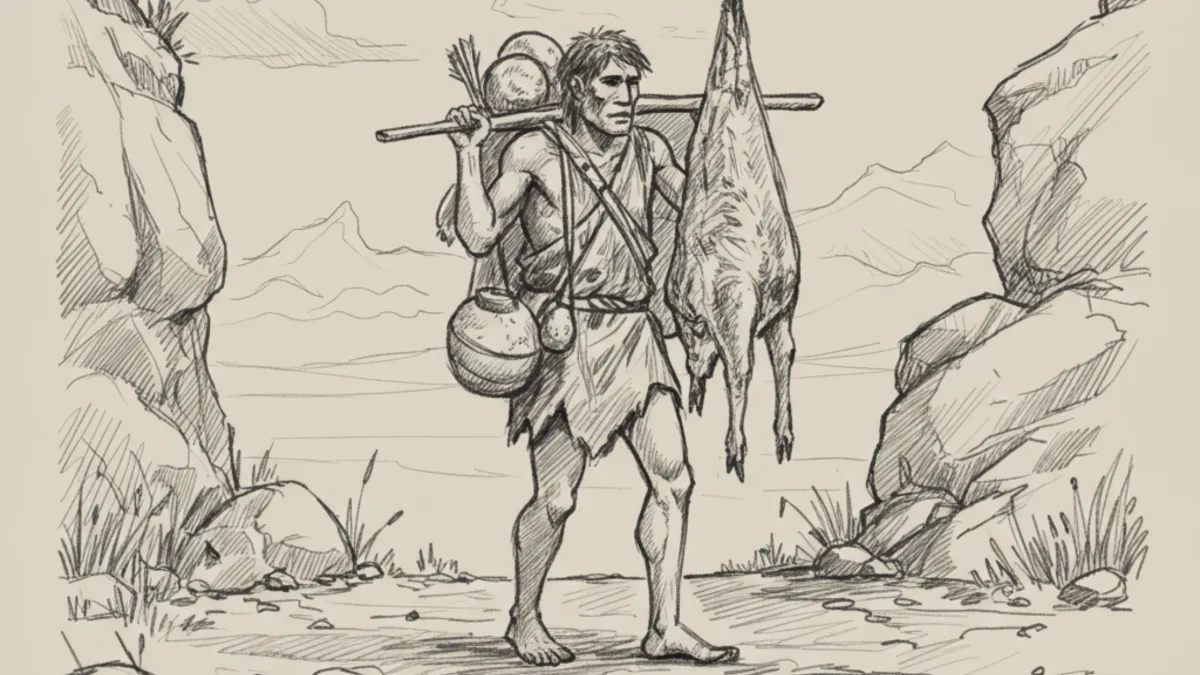
Humans have always carried—food, water, children, weapons. Official Project Grit continues the tradition through modern rucking events.
Carrying Is Our First Strength Training
Long before humans trained for races or stepped into gyms, we carried. We carried food, water, wood, tools, and each other. To survive, you had to shoulder the weight and keep moving.
It’s easy to think of rucking as something invented by the military, but it’s far older than that. Carrying is woven into the fabric of humanity itself. From the first hunter-gatherers to modern endurance athletes, the ability to haul weight over distance has always been a measure of strength, grit, and survival.
Mothers: The Original Ruckers
Across every culture and every era, the most universal expression of carrying has been mothers with their children. For millennia, women carried babies pressed to their chest or strapped to their backs.
Only in recent generations-with strollers, car seat carriers, and endless gadgets-has this timeless act been outsourced. But in much of the world, mothers still ruck their children daily. It’s not fitness. It’s not sport. It’s love, survival, and the first training ground of humanity.

Daily Loads: Food, Water, and Fire
For our ancestors, every day was a ruck. Getting water didn’t mean turning on a tap-it meant walking miles to the nearest river or well, carrying buckets on shoulders or balancing baskets on heads. Cooking wasn’t about opening a fridge-it often began with a long hunt and the heavy work of hauling the kill back home. Feeding your family wasn’t a grocery run-it was carrying harvested food across miles of uneven terrain.
Carrying wasn’t a workout. It was a lifeline. The daily ritual of putting weight on your back was the price of survival.
Warriors and the Burden of Battle
As tribes became armies and armies became nations, load carriage turned into discipline. Soldiers have always carried their lives on their backs: weapons, armor, food, and shelter.
Roman legionaries were nicknamed “Marius’ Mules” because of the enormous loads they marched with.
Medieval soldiers hauled heavy armor, shields, and supplies.
Modern infantry carry rucks weighing 50- 100+ pounds, pushing the limits of endurance as part of their training and deployment.
Marching under load wasn’t optional-it was the foundation of readiness and the only way to survive. Carrying forged warriors long before battle ever began. Carrying was discipline and readiness.
Why Carrying Still Matters
Modern comfort has stripped away this part of our humanity. Machines haul our food. Vehicles transport our water. Devices babysit our children. Most of us go through life without ever feeling the strain of real weight.
But our biology hasn't been forgotten. We were built to carry. Our muscles, joints, lungs, and even our nervous system respond to the demand. Modern science now shows that carrying weight outdoors improves strength, cardiovascular endurance, posture, and even mental health.

Carrying doesn’t just keep us alive- it keeps us human. No matter the continent, carrying weight links us. It’s a shared human experience that transcends borders, class, and time.
Carrying Forward With Official Project Grit
At Official Project Grit, rucking is more than exercise- it’s a way of remembering. For generations, carrying was survival. Our ancestors carried water, food, firewood, and children. They bore the weight because life demanded it.
Today, we choose to carry for different reasons. We carry not to survive, but to grow. We carry to test ourselves, to build resilience, and to strengthen the bonds of community.
Our events are not just endurance challenges. They are living reminders of an ancient truth: when people shoulder weight side by side, they find strength, connection, and purpose.
Your Invitation: Step Into the Lineage
When you strap on a ruck, you’re not just exercising. You’re stepping into humanity’s oldest tradition. You’re joining a lineage that stretches from ancient mothers and soldiers to modern-day pioneers of grit.
Carrying has always been more than transport. It is resilience embodied. And when we choose to carry today-for mental and physical health and to build community-we prove that we are still built for more.
📚 References
Anthropology & Daily Load Carriage
Porter, C. (2016). Carrying burdens: A review of load carrying in developing countries. Medical Research Archives, 4(6). https://doi.org/10.18103/mra.v4i6.762
Heglund, N. C., & Taylor, C. R. (1988). Speed, stride frequency and energy cost per stride: How do they change with body size and load? Journal of Experimental Biology, 138, 301–318. https://doi.org/10.1242/jeb.138.1.301
Mothers & Infant Carrying
Hrdy, S. B. (2009). Mothers and Others: The Evolutionary Origins of Mutual Understanding. Harvard University Press.
Konner, M. (2010). The Evolution of Childhood: Relationships, Emotion, Mind. Harvard University Press.
Military Load Carriage
Knapik, J. J., Reynolds, K. L., & Harman, E. (2004). Soldier load carriage: Historical, physiological, biomechanical, and medical aspects. Military Medicine, 169(1), 45–56. https://doi.org/10.7205/MILMED.169.1.45
Roth, J. P. (1999). The Logistics of the Roman Army at War (264 BC–AD 235). Brill Academic Publishers. (Includes discussion of “Marius’ Mules.”)
Cross-Cultural Carrying Practices
Malville, N. J., & Byrnes, D. A. (2017). Carrying in ancient and modern contexts: Head-loading, back-loading, and shoulder poles.Anthropology of Work Review, 38(2), 79–89. https://doi.org/10.1111/awr.12109


